Most “fake grass” looks fake for one boring reason: it’s installed like a carpet, not built like a lawn.
And if you’ve ever walked across turf that felt like a spongy green welcome mat, you already know what I mean.
Realism starts before the turf roll ever hits the ground
Look, people love to obsess over blade color. I get it. But the base is the make-or-break layer, and it’s invisible once the job is done. The best results happen when Shoreline Synthetic Turf install fake grass with a level of ground prep that’s almost… obsessive.
A proper synthetic lawn is basically a small civil engineering project: the sub-base has to be stable, drain predictably, and hold grade. If any of those are off, the prettiest turf in the world still ends up rippling, holding water, or separating at the edges.
Sometimes I explain it like this to homeowners: you’re not buying grass, you’re buying the system underneath it.
One line, but it’s true.
What makes turf look real (the three visual cues your brain notices)
Your eyes don’t “measure” turf. They interpret patterns. And the patterns that scream plastic are surprisingly consistent.
Here are the three cues that matter most:
– Blade variety (shape + height): Multi-profile fibers with different heights catch light unevenly, like real grass does after mowing or foot traffic. Uniform blades = putting green vibes, whether you want that or not.
– Thatch density: That springy, curly underlayer does more than fluff. It hides backing, masks seams, and creates depth so the lawn doesn’t read flat from the street.
– Color blending: Real lawns aren’t one green. The believable turfs mix field greens with olive tones and subtle tan/amber that mimic sun stress and natural thatch.
Now, this won’t apply to everyone, but… if you’re trying to make turf look perfect, you often make it look fake. Slight irregularity is your friend.
Fibers, backing, infill: the material mix Shoreline leans on
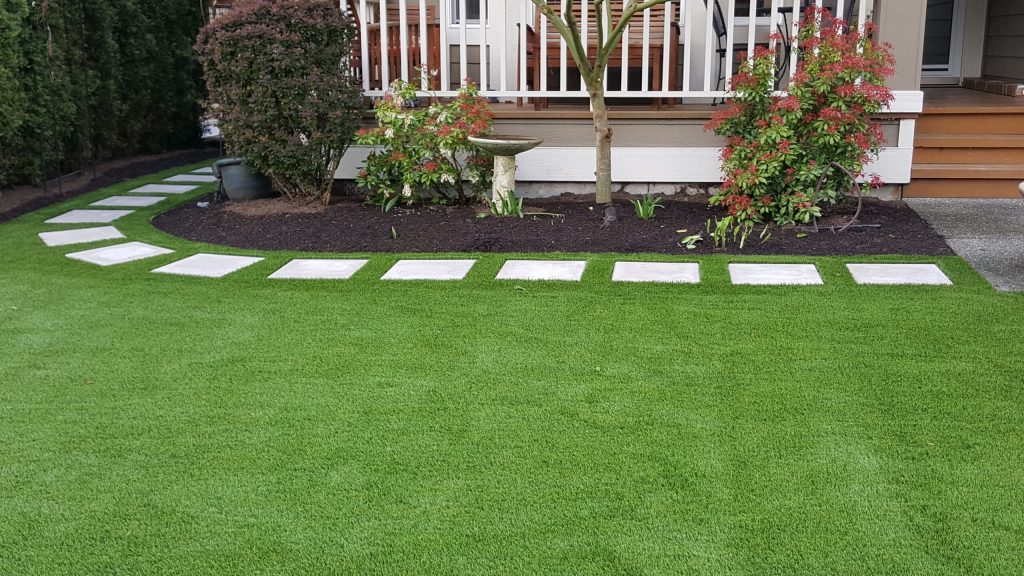
Fibers (where “feel” comes from)
In my experience, the softness people rave about is mostly fiber engineering, not magic infill. The better products use UV-stable polyethylene blends and intentionally varied blade geometry: some fibers provide structure, others provide the soft “hand.”
Blade height matters too, but not in the way most brochures claim. Taller fibers can look lush, sure, yet if the polymer memory is weak they’ll pancake fast, especially in walk paths.
Backing (where durability and drainage live)
Backing is the part nobody asks about until something fails. A quality backing does three things well:
– holds tuft bind so blades don’t shed prematurely
– supports seam integrity (because seams are where installs either look pro or look tragic)
– allows vertical drainage without turning the base into mud soup
And yes, low-VOC backings are a real thing. If you’re sensitive to odors or installing in a tight courtyard, that detail stops being “nice” and starts being non-negotiable.
Infill (not optional, but also not one-size-fits-all)
Here’s the thing: infill is performance tuning. Shoreline typically matches infill to use case, because what works for a front-yard showpiece doesn’t always work for a dog run.
Common options and why they’re chosen:
– Silica sand: stable, budget-friendly, helps fibers stand up
– Rubber (or rubber blends): adds cushioning but can hold heat and odor if poorly specified
– Coated/engineered infills: better odor control, sometimes cooler, typically pricier
– Antimicrobial infill (pet zones): reduces bacterial buildup and that lingering “wet-dog-yard” funk
You can feel a wrong infill choice in about three hot afternoons.
Base prep: the part that separates “installed” from “constructed”
Shoreline’s process lives and dies by three technical controls: sub-base composition, compaction, and slope.
Sub-base and compaction (settlement is the real enemy)
The base is built in lifts and compacted to spec, not “until it looks flat.” That means controlled material gradation and consistent density across the entire footprint, especially near edges and hardscapes where failures love to start.
A useful benchmark from geotech practice: many turf base builds target ~95% compaction (often referenced against Standard Proctor for soils). It’s not a sexy number, but it prevents dips and waves.
Drainage and slope (because puddles make turf look cheap)
Drainage isn’t just about porous backing. Water still has to go somewhere. Shoreline typically grades for runoff, then uses drainage layers and (when needed) collection paths like perforated pipe in a gravel envelope, plus cleanouts so the system can be serviced.
If you’ve ever seen turf with “mystery bubbles” after rain, that’s trapped water and a base that wasn’t given an exit.
A real stat, since people ask: the EPA estimates that nearly 30% of residential outdoor water use goes to landscaping (U.S. EPA, WaterSense). Turf doesn’t solve every water issue, but the drainage planning does double duty, protecting the install and cutting wasteful irrigation habits.
Source: https://www.epa.gov/watersense/statistics-and-facts
Seams and edges: where good installs quietly flex
You can spot a rushed job from a balcony.
Seams telegraph everything: alignment, adhesive work, grain direction, even whether the installer respected the lay pattern. Shoreline’s cleaner jobs use tight seam spacing, proper seam tape, and consistent nap direction so the lawn doesn’t look like patchwork under afternoon sun.
Edges matter just as much. Turf that isn’t properly anchored and finished will curl, migrate, or expose base material. That’s not “wear and tear.” That’s an install problem.
Blade profiles + color mastery (the “don’t make it neon” section)
Some turfs are too glossy. Others are too flat. The sweet spot is a blend of:
– tapered tips (less “straw” look)
– mixed sheen fibers (not everything should reflect light the same way)
– multiple greens plus a controlled amount of tan (controlled is the keyword)
If you want realism, you’re aiming for “healthy lawn from 10 feet away,” not “golf commercial close-up.”
And yes, dye lots matter. Mismatched rolls near a patio edge will haunt you forever (or at least until you can’t unsee it).
Keeping it photo-ready: brushing, rinsing, and not overthinking it
A lot of turf looks tired because it’s never brushed. The blades lay down, the thatch gets compacted, and suddenly the lawn reads dull and lifeless.
A simple maintenance rhythm that actually works:
– Brush high-traffic lanes to stand fibers back up (nylon bristles, not metal)
– Rinse dust/pollen off periodically, especially near roads or pools
– Spot-clean spills with turf-safe cleaner only when needed, don’t turn it into a chemistry experiment
– Check infill levels in play zones so the surface doesn’t get “thin” and shiny
One quick aside: over-wetting can make certain infills behave weirdly, so moderation beats obsession.
Pets and kids: the safety side isn’t marketing fluff
If you’re building a family yard, the priorities shift fast: drainage, cleanliness, traction, and material safety.
Shoreline’s pet- and kid-focused installs usually lean on:
– non-toxic, low-odor materials
– antimicrobial infill options for odor control
– drainage-forward base design to reduce puddles (and the muddy paw problem)
– fibers that resist matting so the surface stays even under play
A turf yard that holds urine smell isn’t “normal.” It’s either poor drainage, wrong infill, or lazy cleaning habits, or some combo of the three.
Timeline: from order to lawn (what the milestones typically look like)
Some projects move fast. Others don’t, and that’s often because the site dictates the pace, access, demolition, grading fixes, drainage needs.
That said, Shoreline’s sequence tends to follow a predictable arc:
1) site check + material selection (fiber style, color blend, infill choice)
2) layout, excavation, and base build
3) compaction + grading verification
4) turf placement, cutting, seaming, edge anchoring
5) infill application + power brooming
6) final walkthrough + care guidance
A good final walkthrough feels almost boring. That’s the point.
Common pitfalls Shoreline actively designs around
I’ve seen the same failures over and over, across brands and budgets. Shoreline avoids them by treating them as preventable, not “just one of those things.”
The usual culprits:
– under-compacted base → waves, sink spots, edge separation
– lazy slope → water pooling, algae, smell issues in pet areas
– bad seam discipline → visible patch lines, fraying, lifting
– wrong infill for the use case → excessive heat, odor retention, or poor resilience
Good turf is a bunch of small correct decisions stacked in the right order.
That’s why it ends up looking real. Not because the brochure said “natural.”
Be the first to reply