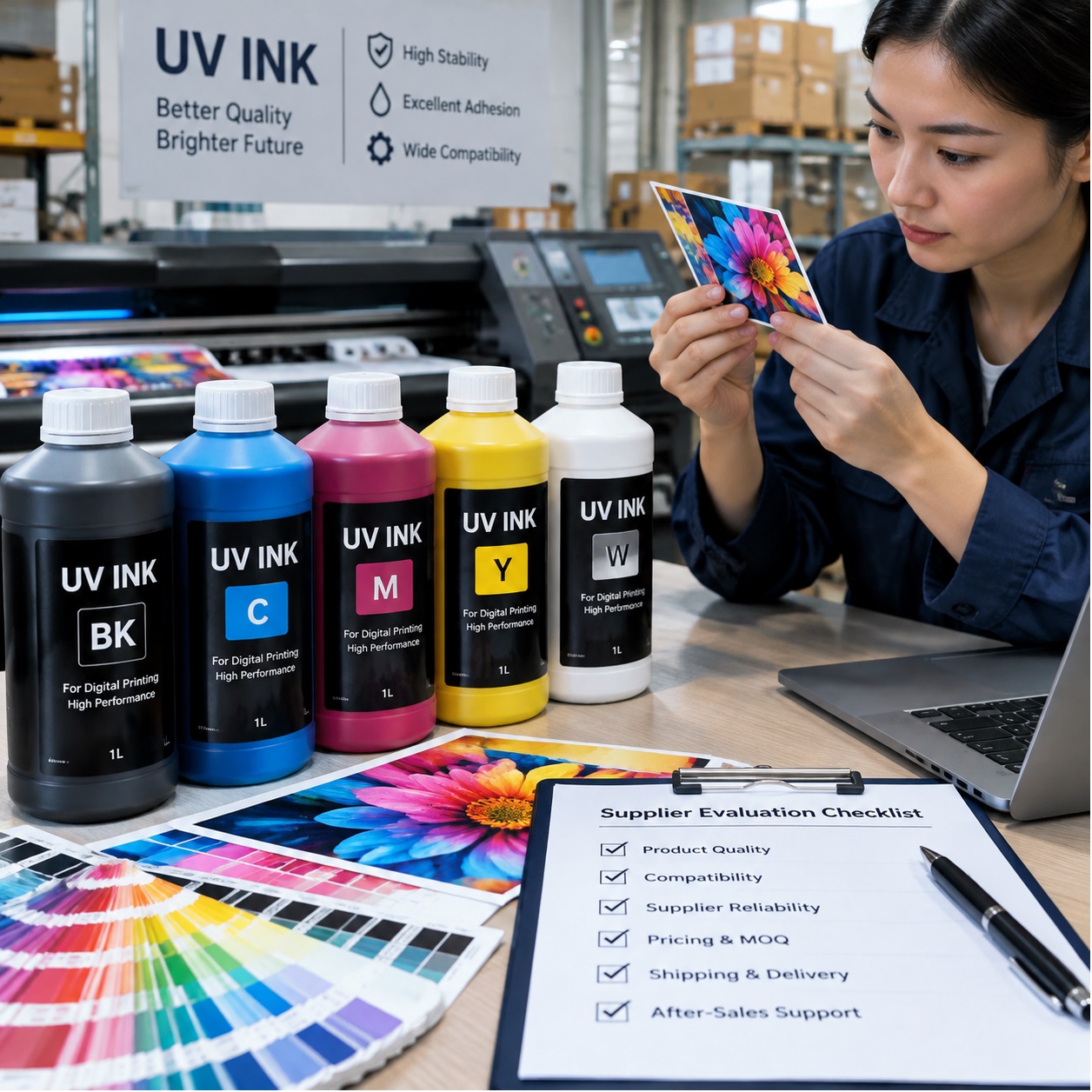
Buying UV Ink in Bulk: How to Evaluate Quality, Compatibility, and Supplier Reliability

Buying UV Ink

The cheapest drum of UV ink you will ever buy is the one that sits in the back of your warehouse for eighteen months because nobody on the floor can get it to cure at line speed.

I have watched that scene play out more times than I care to count. A purchasing manager gets a quote that undercuts the incumbent by 30 percent, feels like a hero, orders a pallet, and three weeks later the production manager is scraping a tacky, half-cured film off a belt while the new vendor’s technical rep stops answering his phone. Bulk UV ink is where the real margin lives. It is also where the real catastrophes live. The difference between the two comes down to three things nobody puts on the spec sheet: quality discipline, chemical compatibility, and whether your supplier will still be standing next to you when something goes wrong at 2 a.m.

Let’s take them one at a time.

What quality actually means in a drum

Price per kilo is a distraction. Cost per good printed unit is the only number that matters, and it is buried under a pile of technical details that most buyers never ask about.

Start with viscosity and how it is specified. Any supplier can quote a number. Ask at what temperature, on what spindle, at what shear rate. UV inks are thixotropic, meaning they behave differently depending on how fast you push them, and a viscosity figure quoted at 25 degrees Celsius tells you almost nothing about how the ink will behave in a flexo pan at 40 degrees or in an inkjet head being jetted at 45. The good suppliers hand over a full rheology curve without being asked twice.

Next, pigment loading and opacity. Cheaper ink usually means less pigment and more filler, and you pay for it in coverage. A white that needs two hits instead of one just doubled your ink consumption and halved your throughput. Ask for drawdowns on your actual substrate, not on a coated lab sheet that flatters everyone.

Then there is batch-to-batch consistency, which is the quiet killer. The first drum is beautiful. The sixth drum prints a half-shade off and your customer’s brand police notice. Ask what color tolerance the supplier holds, typically a Delta E of 1.5 to 2.0 for process colors, and demand a certificate of analysis with every lot. If they cannot produce a COA, they are not a manufacturer. They are a reseller with a drum filler and a website.

Finally, look at filtration and shelf life. Micron rating matters enormously if you are running inkjet or fine-line flexo. Shelf life should be printed on the label with a real date, not a vague “use within a year.” UV inks are not immortal. Photoinitiators can settle, monomers can separate, and an ink that sat in a hot warehouse through July will not behave like the sample you approved in March.

Compatibility is where the money gets lost

This is the part that turns a promising savings into a six-figure mistake.

Substrate first. UV ink does not care how good your press is if the surface energy of the film is wrong. Polypropylene and polyethylene typically need 38 to 42 dynes per centimeter to hold ink, and corona treatment decays over time, sometimes within days. Test the dyne level on the actual roll you are about to run, not on the sample the supplier mailed you. And remember that adhesion is not just about wetting. It is about whether the cured film survives a cross-hatch test, a MEK rub, and a trip through a die cutter without flaking off at the edges.

Then the curing system. This is where I see the most expensive assumptions. A 395 nanometer LED lamp and a standard mercury arc lamp are not interchangeable, and an ink formulated for one will often fail on the other. If you run LED, you need an ink built around photoinitiators that actually absorb at that wavelength. If you run mercury, you have more formulation latitude but also more heat and more ozone to deal with. Tell your supplier exactly what is hanging over your belt, including the age of the lamps, because a lamp at 60 percent of its original output changes everything.

Do not ignore chemistry mixing. Never blend two suppliers’ UV inks in the same sump hoping to stretch a batch. Different oligomer systems can react badly, and you will not find out until you have a gelled pan and a ruined weekend. If you must switch suppliers, drain, purge, and clean properly, and budget the downtime into your savings calculation.

Downstream processes matter too. Lamination, thermoforming, shrink, and food-contact applications each impose their own rules. If the printed package touches food, you need low-migration ink and the documentation to prove it. If the print gets laminated, you need to know how the adhesive behaves against your cured surface. These are questions your supplier should answer with data, not with a confident nod.

How to tell a real supplier from a confident one

Reliability is not a personality trait. It is a set of observable behaviors.

Ask where the ink is made. Ask who makes the pigment dispersions. Ask how many reactors they run and what their monthly capacity is. A supplier who cannot answer these questions is a trading company, which is fine if you know that going in, and catastrophic if you do not.

Ask about lead time and how it behaves under stress. Anybody can ship in three days in a quiet month. What happens in October when everyone is running holiday packaging? Get the answer in writing, with penalties if you can negotiate them.

Look hard at technical support. The best bulk ink suppliers will send an applications engineer to your plant, watch your line run, and adjust the formulation or the cure settings rather than blaming your equipment. The worst will send a PDF and a prayer. Ask for references from printers running similar substrates and similar speeds, then actually call them. Ask the reference what happened the last time they had a problem. The pause before the answer tells you everything.

Check lot traceability and retained samples. If a defect shows up in month four, can the supplier pull the retained sample from that exact batch and compare it against the original approval? If not, you have no recourse and no root cause.

And be honest about the single-source risk. One supplier with a great price is a wonderful thing until a fire, a strike, or a raw material shortage takes them offline. Qualify a second source even if you never use them. It costs you a trial run and buys you insurance.

Run the trial like it matters

Before you sign a bulk contract, get a sample and run it on your equipment, at your fastest speed, on your thinnest and most difficult substrate. Measure adhesion with a cross-hatch test. Check cure with an MEK double rub and a thumb twist at the end of the oven. Measure color against your approved standard. Then leave a sealed sample in a hot room for a month and test it again.

Track the numbers that matter: ink consumption per thousand units, waste rate, downtime, printhead or anilox wear, and rework. A supplier whose ink costs 15 percent more but cuts your waste by a third is not expensive. They are the bargain of the year.

Bulk UV ink buying rewards the printer who asks uncomfortable questions before the purchase order, not after. Get the rheology data, get the COA, get the applications engineer on your floor, and get a second source qualified. Do that, and the drums in your warehouse will be an asset instead of a very expensive lesson.
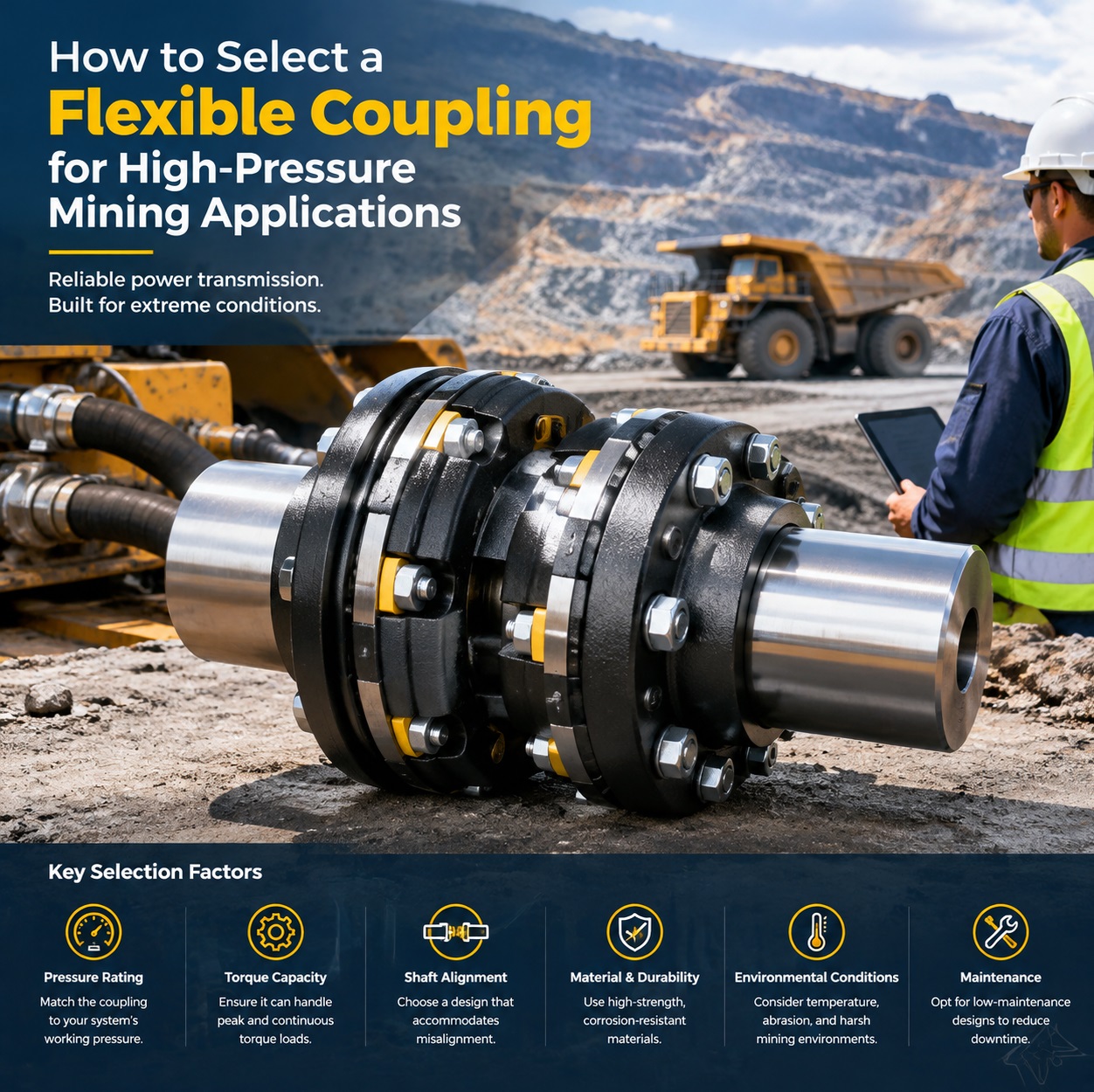
How to Select a Flexible Coupling for High-Pressure Mining Applications


Hydraulic Control System A coupling that costs four hundred dollars can take down a plant that cost four hundred million. That ratio is why the selection process deserves more than a glance at a catalog page and a quick match on bore size.

Twenty-plus years of walking through mill buildings, pump houses, and conveyor transfer stations has taught me one thing about couplings in mining: they almost never fail because someone picked the wrong brand. They fail because someone sized them for the wrong reality. High-pressure duty, abrasive slurry, 24/7 operation, and maintenance crews stretched thin are a combination that punishes every optimistic assumption baked into the original selection.

So let’s strip this down to what actually matters when you’re specifying a flexible coupling for a high-pressure mining application.

START WITH THE TORQUE, NOT THE SHAFT

The first mistake is matching the coupling to the motor shaft diameter and calling it done. Shaft size tells you what fits. Torque tells you what survives.

You need to separate running torque from peak torque. A slurry pump moving high-pressure tailings might run comfortably at 1,200 Nm, then spike to three or four times that in a fraction of a second when a slug of coarse material hits the impeller. A crusher dealing with tramp metal, an apron feeder jamming on a chunk of rock, a conveyor starting fully loaded on an incline, all of these generate transient loads that dwarf the nameplate rating.

Mining service factors usually land between 1.5 and 2.0, but that range is a starting point, not a rule. Positive displacement pumps, reciprocating equipment, and drives with frequent starts push you higher. If the application has ever tripped a breaker or sheared a key, your service factor was too low. Size the coupling for the worst day the machine will ever have, not the average Tuesday.

MISALIGNMENT IS NOT A ONE-TIME PROBLEM

Every coupling in the plant was aligned perfectly on commissioning day. That alignment changes the moment foundations settle, pump casings heat up, or a pipe strain load shifts the housing a few thousandths of an inch.

You have three misalignment types to account for: angular, parallel, and axial. Most mechanical power transmission couplings handle some combination of all three, but the limits vary enormously. Elastomeric couplings forgive a lot of parallel and angular misalignment and absorb shock while they’re at it. Gear couplings handle high torque in a compact package but need continuous lubrication and tight alignment to survive. Disc couplings run clean, handle high speed and high torque with zero backlash, but they don’t damp vibration and they won’t tolerate much parallel offset.

Here’s the practical question: what will the alignment actually look like after two years of operation, not what does it look like on the alignment report? Design for that number.

THE ENVIRONMENT WILL FIND EVERY WEAKNESS

Mining environments are hostile in ways that bench testing never captures. Abrasive dust works its way past seals. Washdown water carries fines into every crevice. Process slurry coats everything within ten feet. Ambient temperatures swing from freezing to over 120 degrees Fahrenheit, and radiant heat from nearby equipment adds another layer.

This is where lubrication requirements become a decision point, not a detail. A gear coupling in a dry, clean, well-maintained drive train can run for decades. That same coupling in a slurry pump application with leaking seals will lose its lubricant, wear its teeth, and fail in months. If you can’t guarantee clean lubrication and regular inspection, choose a coupling that doesn’t need it. Elastomeric, disc, and grid couplings all offer lubrication-free options that hold up in dirty conditions.

Also check your elastomer compound. Standard nitrile is fine for many applications, but high-temperature service, ozone exposure, and certain chemicals demand EPDM, Viton, or a polyurethane element. The wrong compound turns hard and brittle long before its mechanical rating is reached.

TORSIONAL VIBRATION WILL EAT YOUR DRIVE TRAIN

High-pressure applications often involve variable frequency drives, reciprocating pumps, or diesel prime movers, all of which introduce torsional excitation into the system. If the excitation frequency lines up with a natural frequency of the connected equipment, you get resonance, and resonance destroys gearboxes, shafts, and couplings in short order.

Torsional stiffness of the coupling matters here. A very stiff coupling transmits vibration straight through. A softer coupling with good damping characteristics can shift the system away from a resonant condition and absorb the energy before it damages anything downstream.

For anything above a few hundred horsepower, or any drive with a reciprocating component, get a torsional vibration analysis before you commit to a coupling. It’s cheap insurance compared to replacing a gearbox.

THINK ABOUT FAILURE BEFORE IT HAPPENS

Ask yourself what happens when the coupling element wears out. Does it fail gradually with visible warning, or does it let go without notice? Can a maintenance tech replace the element in place, or does the drive need to be moved?

Spacer couplings exist for exactly this reason. On a high-pressure pump where the motor and pump are close-coupled, a spacer design lets you pull the element and even service the pump seal without touching the motor alignment. That single feature can turn a two-day job into a four-hour job.

Consider torque-limiting or shear-pin designs if the cost of a jammed or overloaded drive is catastrophic. Sometimes the smartest engineering decision is deciding what breaks first, and making sure it’s the cheap part.

THE BORING DETAILS THAT SINK INSTALLATIONS

Bore tolerance, keyway fit, hub clamping method, balance grade, and axial float all matter more than most people want to admit. Taper-lock and shrink-disc hubs transmit more torque on smaller shafts than a straight keyed bore, and they’re easier to remove after years of service. Interference fits are common on high-torque applications but require heat or hydraulic assistance to install.

Balance grade becomes critical above roughly 3,600 RPM. Below that, most standard couplings are fine. Above it, specify the balance grade and verify it, because an unbalanced coupling at speed will destroy bearings.

And don’t forget guarding. Rotating couplings injure people. MSHA inspectors will ask about it, and so will your insurance carrier.

DO THE MATH ON TOTAL COST, NOT PURCHASE PRICE

The purchase price of a coupling is almost irrelevant compared to what it costs when it fails. A coupling failure on a critical slurry pump might mean eight hours of lost production, a crew on overtime, and expedited freight on a replacement. Run that number, then compare it to the price difference between an adequate coupling and the right one.

Standardize where you can. Carrying three coupling types across the plant instead of twelve simplifies spares, training, and troubleshooting. But don’t standardize so aggressively that you force the wrong coupling into a demanding application just because it’s already on the shelf.

THE BOTTOM LINE

Selecting a flexible coupling for high-pressure mining duty comes down to honest answers about torque, misalignment, environment, vibration, and maintenance capability. Get those five things right and the coupling becomes the least interesting part of your drive train, which is exactly what you want.

If you’re specifying a new installation or chasing a repeat failure, bring in an application engineer early and give them real data: horsepower, speed, torque profile, misalignment tolerance, temperature range, contamination exposure, and duty cycle. The right coupling for your application exists. The work is in defining your application clearly enough to find it.